 PARIS: It is a little like Internet dating, but the objective is money.
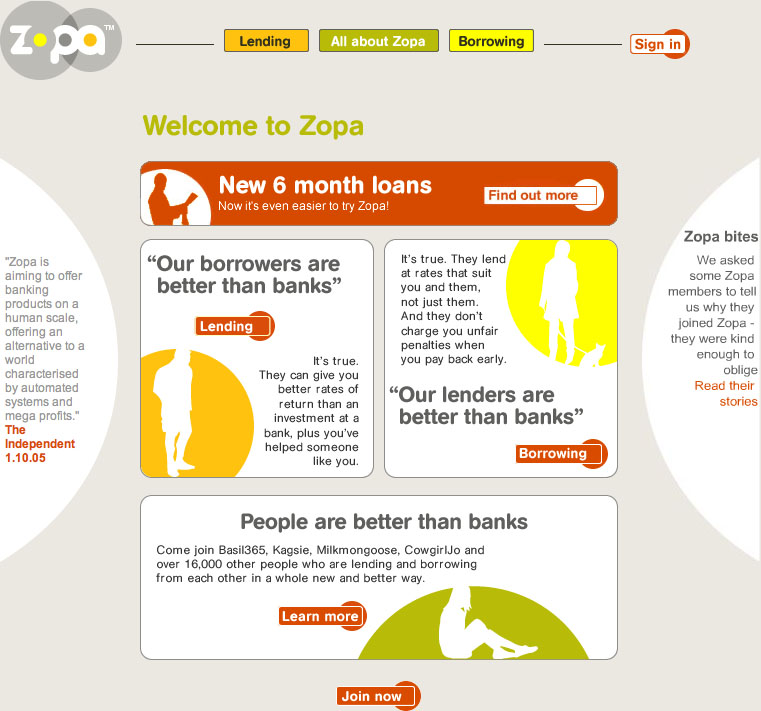
 A Web site based in Britain, Zopa.com, and another in the United States, Prosper.com, have started businesses that connect individuals eager to borrow money to other people willing to lend, offering both sides better interest rates than banks.
"We bring together people who have never met to lend and borrow," said Chris Larsen, co-founder and chief executive of the San Francisco-based Prosper, which has had 140,000 users since it started a year ago. "Somebody who has money should be able to loan it out and somebody looking to borrow should be able to find a lender."
Banking analysts suggest that these hyper-efficient operations, with few employees and no costly real estate, could force changes to established banks.
"As a researcher, these sites make me wonder if the core business model of financial institutions is changing," said Mark Meyer, an analyst at the Filene Research Institute, a Wisconsin-based group that studies credit unions. "We are talking about a potentially disruptive innovation in financial services."
Traditional banks acknowledge the challenge, but emphasize consumer preference for size and experience over low interest rates.
"The existence of Zopa shows that there is now healthy competition in offering consumers a wide range of choices for loans," said Brian Capon, spokesman for the British Bankers' Association, the lead trade association for banks and financial services in Britain.
"But banks," he said, "are considerably bigger and have been in the business of lending money and taking deposits for hundreds of years, so consumers need to go where they feel most comfortable."
Users register on the sites to either borrow or offer their money for loans. Operating with the oversight of the same regulators as regular financial institutions, the sites operate on a "peer- to-peer" basis, yet use classic credit checks to assess borrowers.
Both sites accept clients only from within their country of operation and face several layers of regulation. Zopa is regulated by the Financial Services Authority and the Office of Fair Trading, while Prosper is regulated by the Federal Reserve Board, Federal Trade Commission and laws in each U.S. state.
The sites earn money from fees paid by borrowers and lenders. Zopa, for example, charges borrowers a fee of 0.5 percent of the loan amount and lenders a 0.5 percent annual service fee.
The approaches of the sites differ, with Prosper allowing lenders access to more details about individual borrowers — including photographs — and Zopa emphasizing the rigor of its own borrower vetting process.
"We ask for people's rating on eBay and check what car they drive via the number plate," said James Alexander, chief executive of Zopa, which started in March 2005 and now has 130,000 registered users, of whom 30 percent are lenders. "Taken in isolation these may seem stupid, but they allow us to build up a wider view than just the normal information you give a bank for a loan."
This broad view of borrowers is, of course, aimed at maximizing the number of loans that will be repaid.
In their short span of activity, the sites have maintained very high rates of repayment. Zopa claims a 0.05 percent default rate while Prosper has not had a single default in its top two credit grades. This compares with a default rate of 0.4 percent for borrowers with perfect credit in the United States.
The combined value of all loans by the two sites — more than $30 million by Prosper and "many millions of pounds" by Zopa — are small compared to the £3 billion, or $5.8 billion, of new personal loans offered each month by traditional British banks.
But some banking analysts see their solidarity, simplicity and cost savings as something the banking industry may seek to emulate.
The sites operate under the same principles as credit unions, where individuals pool their money for borrowing and lending. But instead of customers who share the same employer, ethnicity or profession, the lending sites connect total strangers.
"If you close your eyes, the Zopa description sounds exactly like a local credit union of the 1950s," said Meyer, of the Filene Research Institute. "The difference is that the Internet brings borrowers and lenders together across great geographic distances."
Take John Etherington, who needed a loan, and Mauro Lazzara, who had some spare money.
Etherington, 54, a truck driver based in Newport, East Yorkshire, needed £2,000 to replace the double-glazed windows in his house. The banks offered interest rates above 9 percent for periods of at least five years, with hefty penalties for paying off loans early.
"The banks are not very sympathetic, even when you want to repay them early," Etherington said. "Even so, it used to be that you had no choice but to go through them."
By surfing the Internet, however, Etherington found Zopa, where he found a loan at 6 percent interest for three years, with no penalty for early repayment.
Getting the loan required providing Zopa with similar credit information as a bank, but approval took just four days. A bank loan would have taken weeks to clear and required several visits to the branch, Etherington said.
"Unlike the bank, I don't resent the person who loaned me the money," Etherington said. "I'm happy to pay that person, whoever it might be."
Etherington sends his loan payments to Zopa, which dispatches them to all of the lenders whose money made up the loan. Should he fail to make payments, Zopa uses similar recovery procedures to a bank, including an eventual downgrade of Etherington's consumer credit rating.
One of the people lending the money to Etherington might be Lazzara, 36, an oil engineer in Aberdeen, Scotland, who last year invested £1,000 with Zopa after reading about it in a newspaper.
"It is not just the interest I earn, but I like the idea of lending my money directly to help other people," Lazzara said.
At Zopa, lenders can select the term of the loan — from one to five years — as well as the credit rating of borrower they wish. Borrowers with a bad consumer credit rating pay more interest, but have a higher chance of default.
For all of their credit safeguards, the low lending rates could draw borrowers who do not intend to repay the loans, said Jim Bruene, editor of the Online Banking Report, a newsletter based in Seattle.
"The dirty and ugly truth is that all lending attracts scammers, even if the default rates do not yet show it," Bruene said. "Every loan business has to deal with levels of deceit."
---
By Thomas Crampton, The International Herald Tribune


No comments:
Post a Comment